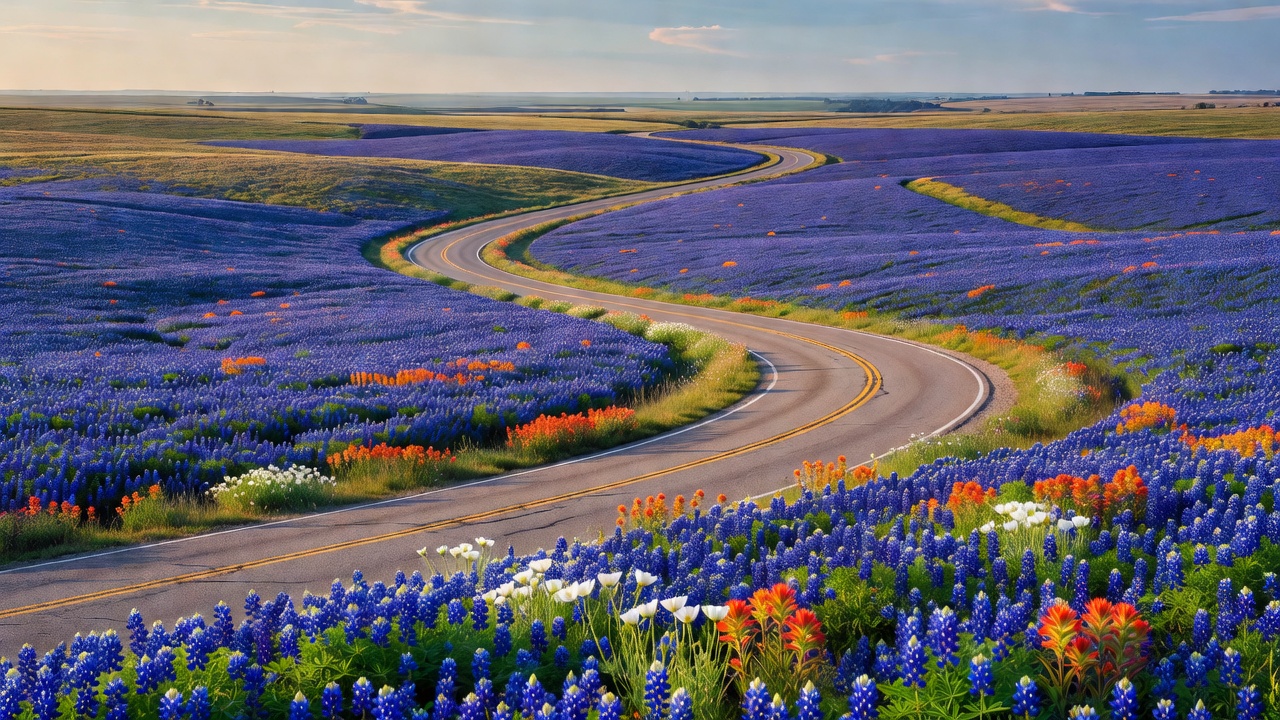
Unlike commercial tulip fields planted in orderly rows, the Texas state flower grows wild. Scattered by the wind and cultivated along highway margins by state highway departments, bluebonnets offer a thrilling, treasure-hunt style road trip. The Texas Hill Country, roughly bounded by Austin to the east, San Antonio to the south, and Fredericksburg to the west, is ground zero for this annual phenomenon.
The Iconic Routes
Finding the best patches requires covering some ground, as the intensity of the bloom shifts weekly based on rainfall and soil temperatures. The most famous drive is the Willow City Loop, a narrow 13-mile scenic route traversing rugged terrain, deep canyons, and meadows that explode with color. Because this road cuts through private property, drivers are strictly required to stay on the pavement and refrain from parking on the shoulder.
For those looking for a longer drive, Highway 281 stretching between Johnson City and Burnet (often heralded as the "Bluebonnet Capital of Texas") offers sweeping views and wide shoulders that make pulling over for photographs safe and legal.
Where to Stop
Because stopping on rural farm-to-market roads can be hazardous, state parks provide some of the safest and most reliable locations for flower viewing:
- Enchanted Rock State Natural Area: The pink granite dome provides a stark, stunning contrast to the soft blue flowers carpeting its base.
- Lyndon B. Johnson State Park: Excellent historic backdrops and well-maintained trails ensure great viewing without trespassing on private land.
- Inks Lake State Park: The combination of water, rocky outcrops, and wildflowers makes for exceptional landscape photography.
Pros and Cons of the Trip
Pros
- Completely free to drive the routes and view the flowers.
- A truly wild, organic experience compared to farmed flowers.
- Fantastic barbecue and historic towns dotting the driving routes.
Cons
- Blooms are entirely dependent on winter rain and can be sparse in drought years.
- Private property laws in Texas are strict; trespassing for photos is illegal and dangerous.
- Wildlife hazards, including rattlesnakes, hiding in the tall grass.
Practicalities & Safety
While the driving routes are free, entering State Parks will require a day-use fee (typically $5 to $8 per adult). Advanced reservations for parks like Enchanted Rock are strongly recommended during the spring season, as they frequently reach capacity by mid-morning.
When posing for photographs—a cherished Texas tradition—always inspect the patch of flowers before sitting down. Fire ant mounds are prevalent throughout the Hill Country, and disturbing one will quickly ruin your road trip. Additionally, be mindful of where you park; pulling onto dry, tall grass with a hot car exhaust can inadvertently start a brush fire.
Lodging & Logistics
Fredericksburg serves as the ideal hub for a Hill Country road trip. The town offers an array of accommodations ranging from luxury bed-and-breakfasts to rustic cabins, alongside a booming local wine industry. Securing lodging should be done months in advance, as the spring wildflower season coincides with peak tourism for the region.